Resume Guide
DEVELOPING RESUME CONTENT FROM YOUR EXPERIENCES
Step 1: Brainstorm your previous and current experiences: work, internship, student leadership, volunteer, research with faculty, class projects, or anything else where you gained experience you would like to share with an employer. Once you have college and professional experiences, focus on these unless a high school activity is highly relevant.
Step 2: Reflect on your impact and consider:
- What is/was your role? Why does/did your role exist?
- What skills, traits, and knowledge does/did it take to successfully perform your tasks/duties?
- What are the measures of success within your role? Or for the company or department itself?
Step 3: Write strong bullet points detailing your experience. Start each with an action verb, describe what you did, how you did it and the results you achieved. Use specific details and quantifiable information whenever possible. See the Writing Strong Bullet Statements handout for more details.
Using AI Effectively: AI can help you brainstorm ideas, organize your thoughts and proofread your writing. AI should assist and not replace your work. Your authentic voice and experiences should remain at the center of the process. Be mindful of the benefits and risks of using AI and review the Using A.I. in Your Job Search handout for additional guidance.
FORMATTING THE RESUME
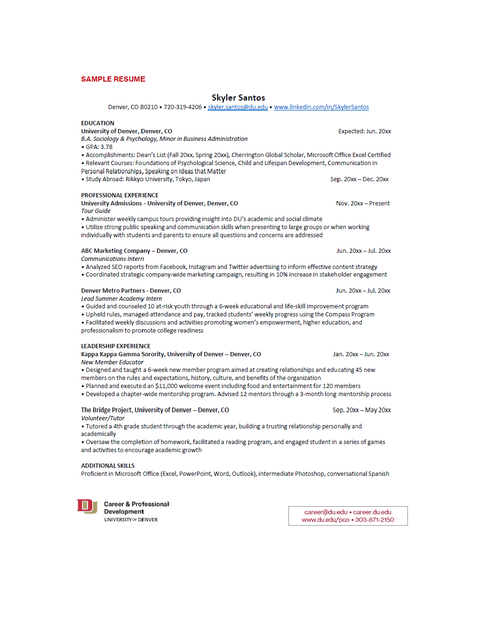
Most recruiters only spend 7-10 seconds on a 1st resume scan. Make key information easy to find:
- Start with a blank Word or Google Docs document. Avoid using templates.
- Use a simple easy to read font: Times New Roman, Arial, or Calibri. Minimize any color.
- Keep font size consistent. Use 11 or 12 pt. No lower than 10 pt.
- Make your name slightly larger (14 or 16 pt. font).
- Use½” to 1” margins on all sides
- Exclude personal details: photo, birthday, and other personal information.
- Be consistent with formatting (e.g., if dates are bolded in one section, bold them throughout)
List education first unless you have significant professional experience. Include:
- School name, type of degree (e.g., “Bachelor of Science”), and major/minors.
- Graduation date—don’t include the start date, even if you’re still in school.
- Any achievements such as a high GPA*, honors, relevant or important scholarships.
- Study abroad experiences. Include university, location, and date range (include months and years).
- Optional: relevant coursework and projects
- Some industries require GPA, even if it’s low. Check with a career advisor if you’re unsure about including GPA.
The bulk of your resume will consist of blocks detailing your past experiences, from most recent to oldest.
- Include your position title, the organization/company name, the city and state, and the date range you were there (include months and years).
- Add 2-5 accomplishment-focused bullet points per role. Use more bullets
